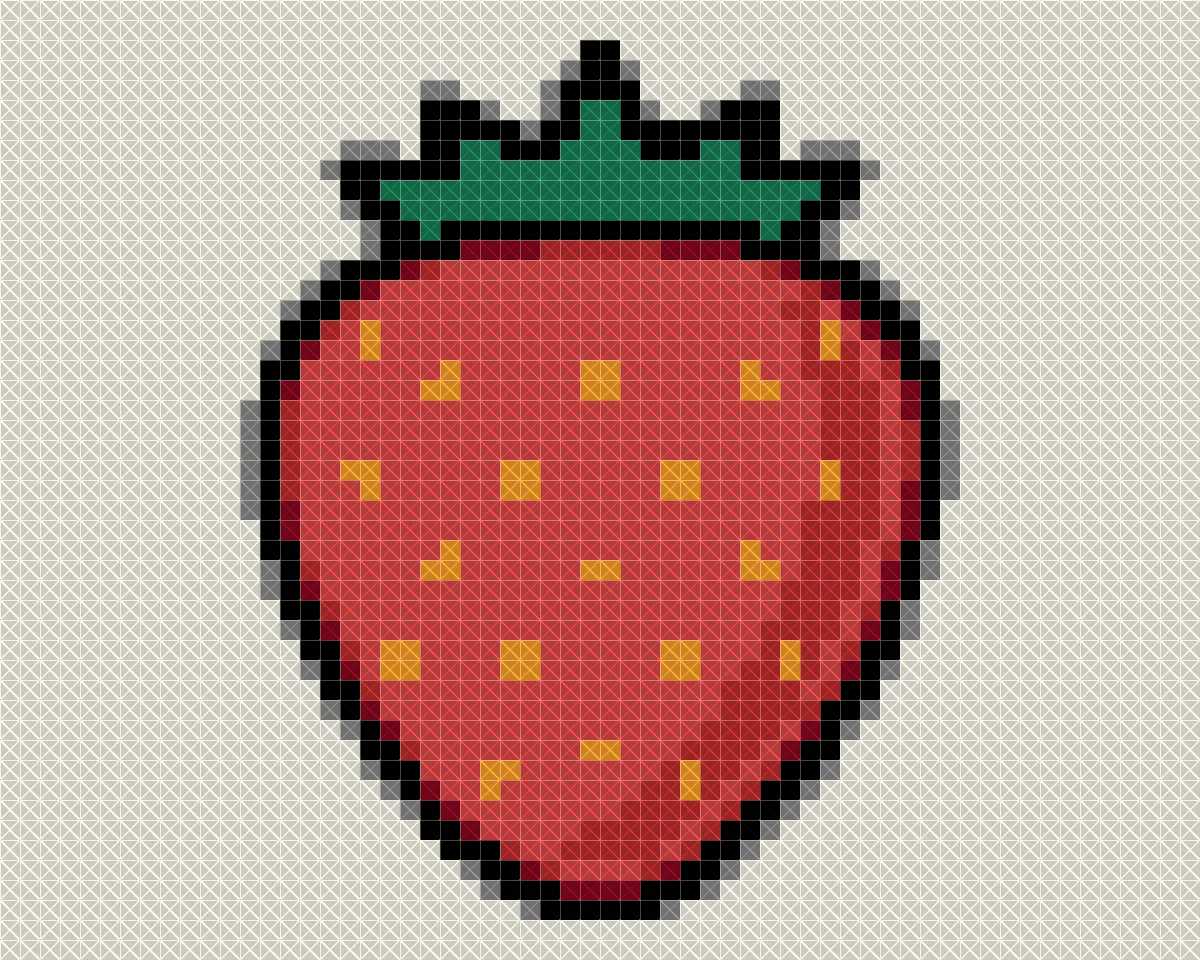
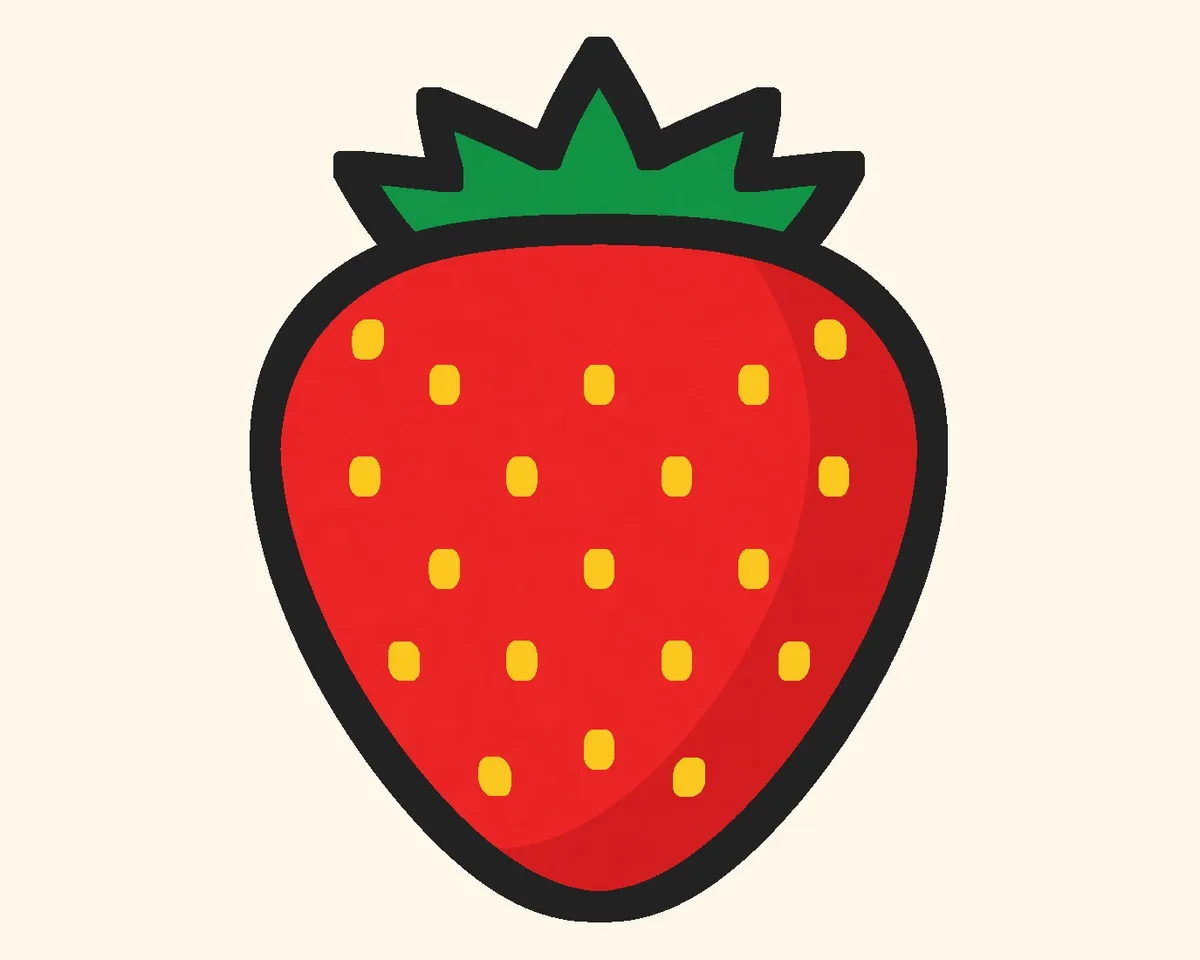
1 pattern
For one project
$5.99USD
$5.99 per pattern
Buy 1 patternSet a 20 to 60 stitch width and up to 10 DMC colors, then preview a mini chart before you download the PDF.
Upload a photo and see your pattern in seconds. No account needed to preview.
Upload a portrait, pet or landscape. The studio opens with your photo: crop it, choose the size and colours, and check the printable PDF. No account needed until you download.
Rather chart it yourself? Start from a blank grid
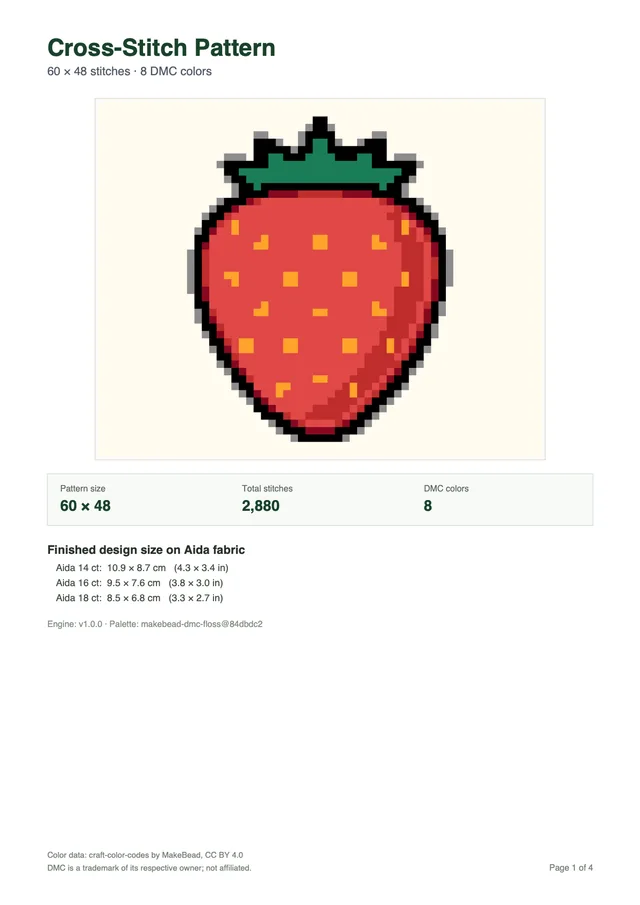
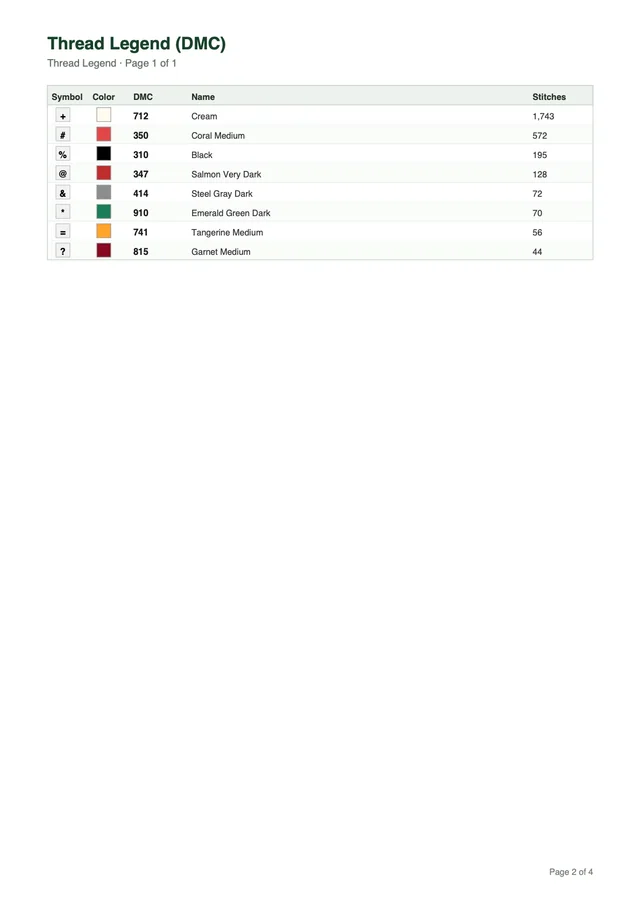
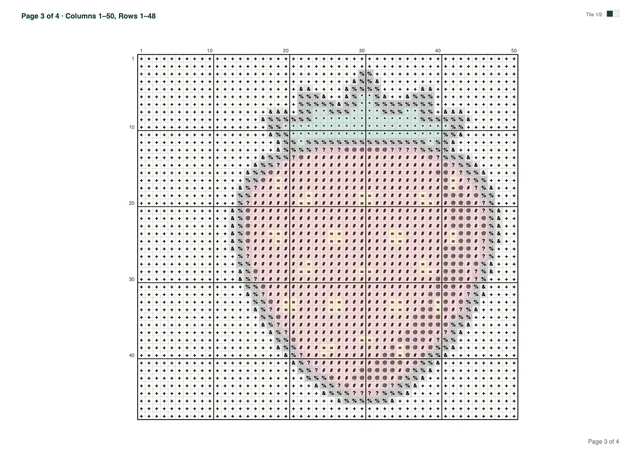
Every download is a multi-page PDF built from your pattern, not a screenshot. This sample was made from the mini design above.
Want a different subject? Browse all 67 free patterns
Previewing is free. You pay only when you download a new pattern.
Your first pattern is free Sign up and get 1 credit. No card needed.
Make my patternFor one project
$5.99USD
$5.99 per pattern
Buy 1 patternOne for you, two to give
$12.99USD
$17.97 if bought one by oneSave 27%
$4.33 per pattern
Buy 3 patternsFor the whole family
$19.99USD
$35.94 if bought one by oneSave 44%
$3.33 per pattern
Buy 6 patternsPrices in USD, excluding tax: VAT or sales tax is added at checkout where it applies. Payments by Paddle, our merchant of record. By buying you agree to the Terms of Service and the Refund Policy.
A small cross stitch pattern turns a simple design into a fast needlework project. Quick mini charts let crafters complete charming motifs in a single weekend. When you sign up for an account on our website, you get 1 free credit to build your first clean chart. You can test ideas without committing months to a massive wall hanging.
Miniature embroidery charts suit beginners and experienced stitchers who want rapid finishes. Working across a compact grid keeps floss handling straightforward and reduces sorting time. You spend fewer hours untangling threads and more time finishing portable gifts. The Cross Stitch pattern maker converts your cropped images into clear charts ready for your needle. If you want a ready-made first project instead, download one of our free beginner cross stitch patterns.
Smaller projects also reduce the overall cost of materials. Instead of buying dozens of specialty skeins, you complete an entire motif with a handful of common colors. Leftover floss from previous projects often covers your thread requirements completely. That efficiency makes mini stitching an accessible hobby for everyone.
Working on a compact scale also makes needlework highly portable. You can pack a four-inch hoop and a few pre-cut threads into a small travel pouch. Commuters and travelers can stitch relaxing rows while riding trains or waiting in quiet spaces. Small projects offer complete creative satisfaction without overwhelming your daily routine.
Finishing a project quickly also provides a wonderful mental boost. Beginning stitchers gain confidence as they watch a complete motif emerge in just a few sessions. Experienced crafters enjoy the refreshing change of pace between large multi-page charts. A mini design delivers that satisfying sense of completion in just a few sittings.
Mini counted charts capture recognizable shapes through clear silhouettes and strong contrast. Bold outlines remain visible on tiny grids.
Compact charts thrive on clean geometry. An icon, a single garden blossom, a fruit slice, or an emblem renders distinctly across a miniature grid. When an image relies on strong tonal contrast, your eyes connect adjacent squares into a cohesive picture. Choosing subjects with definite contours ensures that every square contributes directly to the motif.
Subtle facial expressions and crowded group pictures fail on a compact grid. When you reduce a complex human face to forty stitches across, delicate features turn into muddy blocks of color. Group scenes lose individual identities because there are not enough stitches to map distinct features. For detailed human subjects, consider our portrait cross stitch pattern generator at larger widths instead.
Mini charts also excel when displaying simple domestic objects and nature motifs. A coffee cup, an autumn leaf, a miniature cat silhouette, or a solitary pine tree retains immediate charm. You can explore our pet portrait cross stitch pattern options for dedicated animal designs. Keep your subject singular and striking so each square defines the intended shape.
Clear visual hierarchy matters more on small grids than on large canvases. If a source image contains multiple competing elements, the miniature chart appears noisy and unreadable. By focusing on a solitary focal point, you preserve visual impact across limited cloth space. Bold visual themes always yield superior miniature needlework.
Simple botanical elements also stitch up beautifully at small dimensions. A single rosebud, a sprig of lavender, or a plump strawberry requires only a few dozen stitches to look recognizable. These miniature nature studies make wonderful quick presents for friends and gardening enthusiasts. Tightly focused nature motifs remain perennial favorites among counted thread enthusiasts everywhere.
Architectural details can also work if you focus on a single element rather than an entire building. A tiny arched window, a brick chimney, or a rustic front door translates cleanly into a dozen stitches. If you want to depict an entire house with lawns and roofs, our custom cross stitch pattern options provide the extra width needed for architectural accuracy. Isolating small structural fragments keeps your miniature chart legible and fun to stitch.
Stylized animal tracks and tiny paw prints also translate wonderfully onto compact fabric squares. A bear track or puppy paw creates an unmistakable silhouette with only two or three floss shades. Children and outdoor enthusiasts adore these playful nature motifs on backpacks and hats. Simple symbols convey immediate meaning without demanding intricate thread blends.
Set width between 20 and 60 stitches and palette limits between 2 and 10 colors. This range keeps your mini design crisp and stitchable.
The Cross Stitch pattern maker offers width presets of 50, 80, 100, 150, and 200, plus custom widths from 10 to 300 stitches. For miniature projects, choose a custom width between 20 and 60 stitches. The 50 preset sits directly inside this ideal band. A 50 by 50 chart on 14-count Aida finishes at 3.6 inches wide, fitting neatly inside a 4-inch display hoop.
Limiting your thread palette is equally vital for small charts. The pattern maker includes color presets of 10, 20, 30, 40, and 50 shades, with custom options from 2 to 50 colors. For mini charts, keep your selection between 2 and 10 colors, where the 10 preset represents the practical ceiling. Excess colors create single stray stitches across tiny areas, which slows your stitching without improving clarity.
Floss matching uses CIELAB color math and CIEDE2000 calculations against 489 DMC shades from the MakeBead dmc-floss dataset, while palette reduction relies on Median Cut and k-means clustering. In our own test across 11 local photos at 100 stitches wide and 30 max colors, mean CIEDE2000 sat between 1.8 and 6.8. The conversion algorithm tested at at most 47 ms in Node. Highly saturated cyan can sit about 8 Delta E from screen blue due to cotton dye limits.
To calculate your physical fabric requirements, divide the total stitch count by the fabric count of your cloth. For example, 50 stitches divided by 14 equals 3.6 inches. On 16-count fabric, 50 stitches divided by 16 yields 3.1 inches. The following table details exact finished dimensions across standard miniature stitch widths and popular Aida fabric counts.
| Stitch Width | 14-Count Aida (in / cm) | 16-Count Aida (in / cm) | 18-Count Aida (in / cm) |
|---|---|---|---|
| 30 stitches | 2.1 in (5.3 cm) | 1.9 in (4.8 cm) | 1.7 in (4.2 cm) |
| 40 stitches | 2.9 in (7.4 cm) | 2.5 in (6.4 cm) | 2.2 in (5.6 cm) |
| 50 stitches | 3.6 in (9.1 cm) | 3.1 in (7.9 cm) | 2.8 in (7.1 cm) |
| 60 stitches | 4.3 in (10.9 cm) | 3.8 in (9.7 cm) | 3.3 in (8.4 cm) |
Always add 2 to 3 inches of spare fabric per side beyond these calculated dimensions. Extra border fabric allows you to mount the cloth securely into working hoops without distorting outer stitches. For larger heirloom projects with extensive color blends, explore our full coverage cross stitch pattern generator.
Choosing between 14-count, 16-count, and 18-count Aida also influences how comfortable the project feels in your hands. Beginners often favor 14-count Aida because the woven squares are clearly visible without extra magnification. Experienced stitchers who want sharper edges and smaller physical motifs frequently choose 18-count cloth. Both options produce durable, beautiful needlework when paired with appropriate needle sizes.
Stitching density also affects thread coverage across your chosen fabric count. On 14-count Aida, two strands of embroidery floss provide balanced coverage that allows the fabric texture to breathe. On tighter 18-count cloth, two strands create dense, solid color blocks with virtually no visible canvas beneath. Testing a small ten-stitch swatch helps you choose the thread density you enjoy most.
Pictures with clean silhouettes and solid color blocks stay readable on mini grids. High contrast prevents shapes from blending together.
The Cross Stitch pattern maker converts uploaded JPEG, PNG, and WebP files up to 20 MB and 8,000 pixels per side directly into stitches. It does not perform automatic background removal. If your source photo has a cluttered background, those stray pixels become unwanted stitches. You must crop your picture tightly before uploading so your intended subject fills the entire frame.
High-contrast graphics, crisp vector art, clean logos, and uncluttered snapshots convert best. High-contrast subjects prevent color muddling along borders. When dark foregrounds meet light backgrounds, the grid forms sharp boundaries. For text-based needlework projects, check our cross stitch quote pattern page for lettering layouts.
Every chart generation benefits from careful review before you begin stitching. The browser pattern maker renders a live preview of your chart directly on your screen without requiring software downloads. You can evaluate symbol clarity and adjust grid width interactively. The preview allows you to test multiple color limits and width settings in seconds.
Follow these proven steps when preparing an image for mini chart conversion. Proper preparation ensures that your motif remains clear and easy to read on fabric:
Our printable PDF packages format charts for standard Letter or A4 paper. Each document contains a cover page, a complete DMC thread legend, tiled symbol pages, bold grid lines every 10 stitches, edge coordinates, and a page minimap. Standard chart tiles span 50 stitches wide by 60 stitches tall. Our mini sample above measures 60 by 48 stitches with 8 colors and spans just 4 pages, far fewer sheets than a large photo chart.
Learning how to make a cross stitch pattern helps you master photo preparation before uploading. Cropping out unneeded sky, wallpaper, and furniture leaves every available square for your central design. Good pre-cropping turns an ordinary digital snapshot into an extraordinary counted needlework pattern.
Taking time to test different lighting conditions also pays dividends when working from photography. Direct sunlight creates harsh specular glare on shiny surfaces, which can introduce artificial white specks into your digital palette. Diffused indoor lighting or overcast outdoor conditions provide the most balanced color tones. Clean source lighting makes the pattern generator’s automated color mapping far more reliable.
Mini counted designs fit standard 3-inch and 4-inch wooden hoops, round ornament blanks, and greeting card apertures. These formats provide fast, clean frames.
Framing your finished stitching in a round wooden embroidery hoop creates an instant wall display. A 50-stitch design on 14-count Aida measures 3.6 inches across, which drops effortlessly into a 4-inch hoop with comfortable margin space. A 40-stitch motif on 18-count Aida finishes at 2.2 inches, providing an ideal scale for a compact 3-inch hoop. Wooden hoops are lightweight, inexpensive, and readily available at craft stores.
Holiday ornaments represent another popular destination for miniature counted needlework. Circular acrylic or wooden ornament blanks often feature mounting windows between 2.5 and 3.5 inches across. Stitching on 16-count or 18-count Aida keeps your stitch dimensions compact enough to fit inside these protective casings. Padded backing board and decorative cord finishing turn small motifs into cherished seasonal keepsakes.
Handmade greeting cards with pre-cut tri-fold apertures showcase small needlework beautifully. Most card apertures measure between 2.5 and 3.5 inches in square, oval, or circular openings. You secure the finished Aida behind the aperture using double-sided acid-free tape. The recipient receives a unique textured greeting that they can display on a mantle or frame permanently.
You can also mount mini stitchery into wearable accessories like pendant bezels, keychains, and decorative metal pin frames. Working on higher fabric counts like 18-count Aida produces intricate jewelry-scale artwork. Because miniature projects finish quickly, you can produce matching sets of gifts for family and friends in a few stitching sessions. Small stitch counts let you experiment with creative display ideas without financial risk.
Small gifts bring tremendous joy to friends, coworkers, and family members throughout the year. You can stitch a personalized initial, a tiny festive wreath, or a playful icon in just an evening or two. Finishing these quick tokens builds stitching momentum and helps you clear out leftover floss remnants from your craft basket. Everyone appreciates the care and attention that handmade needlework conveys.
Miniature embroidery also provides an ideal format for testing unfamiliar stitching methods. You can practice new thread tension techniques, experiment with loop starts, or evaluate different hoop bindings on a low-stakes piece. If a particular fabric weave feels uncomfortable, you have only invested a few hours of effort. That low pressure makes small charts an inviting playground for skill building.
Patch projects offer another fun way to use finished mini embroideries. You can turn a completed fifty-stitch square into an iron-on patch for a denim jacket or tote bag. Simply finish the raw cloth edges with liquid seam sealant and attach heat-activated adhesive backing. These custom textile patches add distinct handmade personality to everyday garments and canvas bags.
Sign up for a free account on our website to receive one free credit. You can test different images, adjust your grid between 20 and 60 stitches, and inspect your full-cross preview in real time. Once your design looks balanced, use one credit to download your complete printable PDF chart and begin stitching your custom small cross stitch pattern today.
A grid width between 20 and 60 stitches works best for mini needlework projects. On 14-count Aida, a 50 by 50 chart finishes at 3.6 inches across, which fits standard 4-inch display hoops. Keep colors between 2 and 10 shades to prevent visual clutter.
No. The Cross Stitch pattern maker converts your uploaded image directly into counted stitches without background removal. To isolate your subject, crop your picture tightly before uploading so the motif fills the frame. This step keeps unnecessary background squares out of your mini chart.
No. The tool converts uploaded images strictly into counted full-cross stitches. It does not export backstitch outlines, French knots, or fractional stitches. Clean geometric subjects with bold edges render best under these full-cross rules.
Set your palette between 2 and 10 DMC colors for the cleanest result. Selecting 20 to 50 shades on a 40-stitch grid causes single-stitch speckling that complicates stitching. A tight palette groups matching tones together and keeps your mini design crisp.
New members receive 1 free credit when they sign up with Google. Generating a new PDF pattern costs 1 credit, while repeat downloads of that same PDF cost nothing. You can adjust dimensions and preview unlimited charts in your browser for free.
Ready to start your next miniature embroidery project? Upload your favorite picture, select your grid dimensions, and create your custom small cross stitch pattern in seconds. Sign up with Google to claim your free credit, preview your counted chart in the browser, and download your printable PDF today.
Try for freeUpload a photo and see your pattern in seconds. No account needed to preview.