
1 pattern
For one project
$5.99USD
$5.99 per pattern
Buy 1 patternA favorite face. A much-loved pet. Our cross stitch pattern maker turns the photos that mean something to you into a chart you can stitch yourself.
Upload a photo and see your pattern in seconds. No account needed to preview.
Upload a portrait, pet or landscape. The studio opens with your photo: crop it, choose the size and colours, and check the printable PDF. No account needed until you download.
Rather chart it yourself? Start from a blank grid
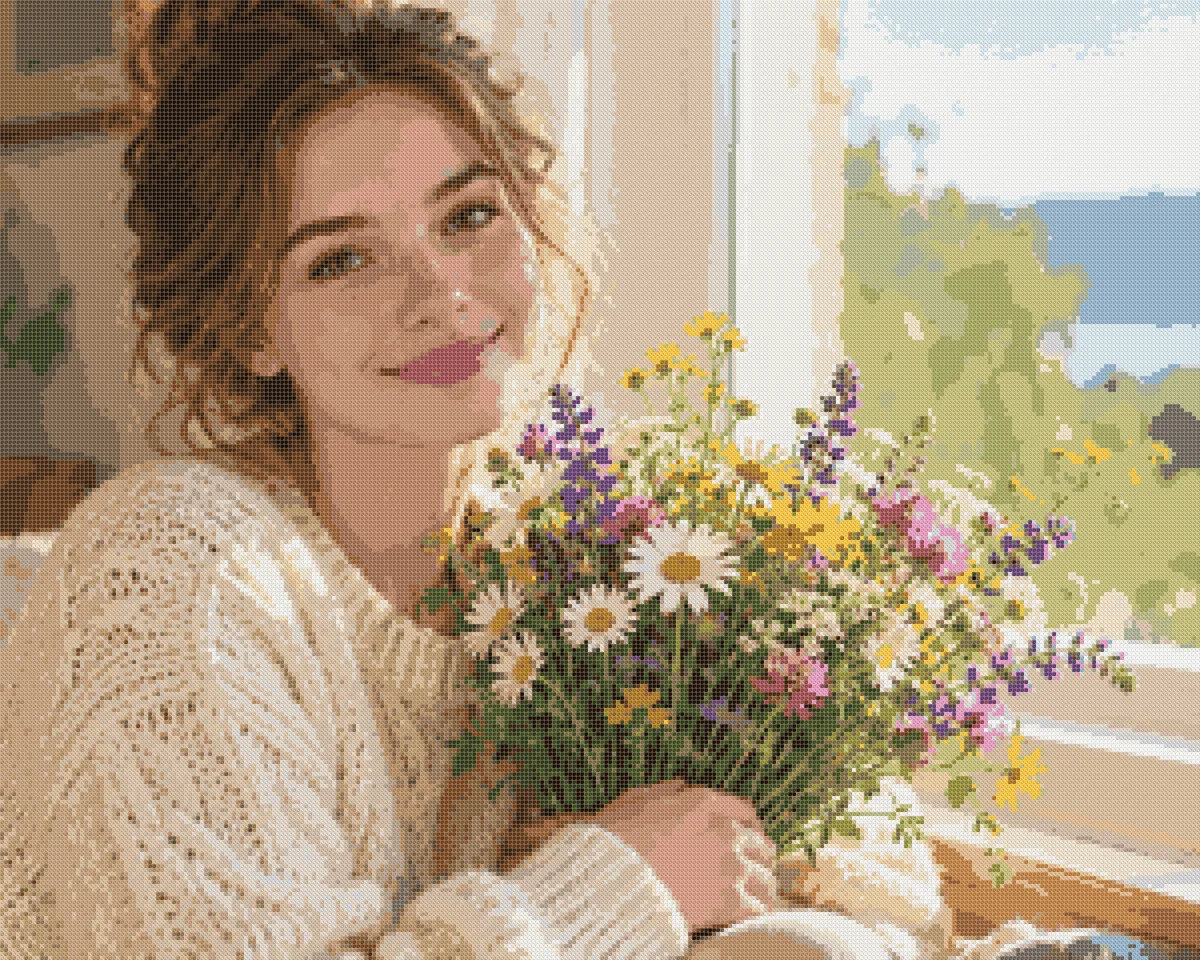
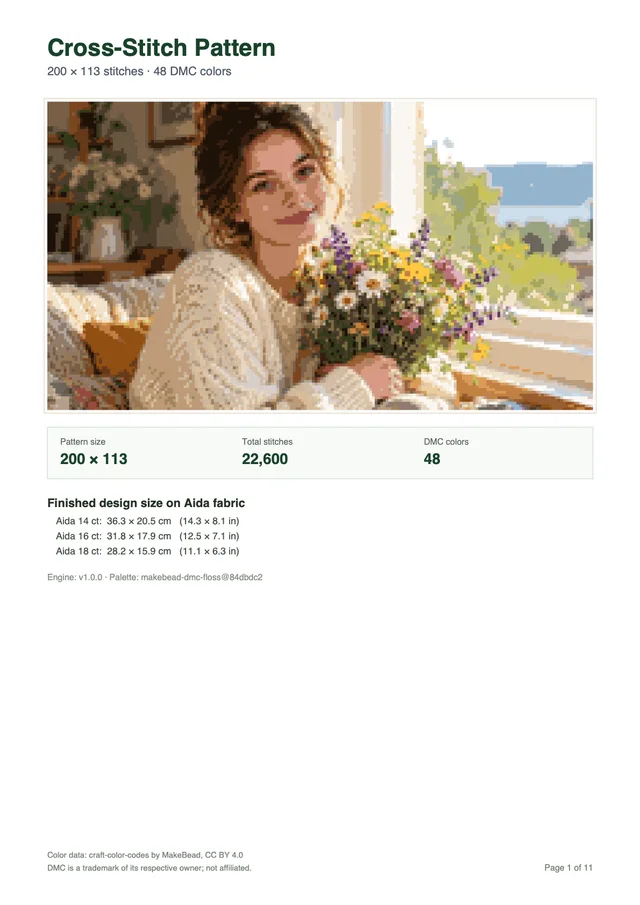
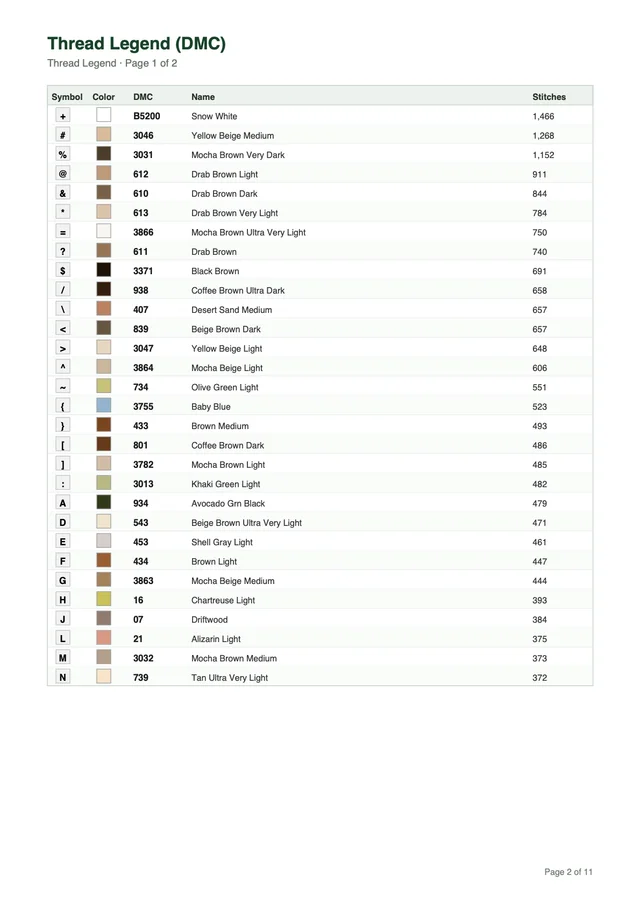
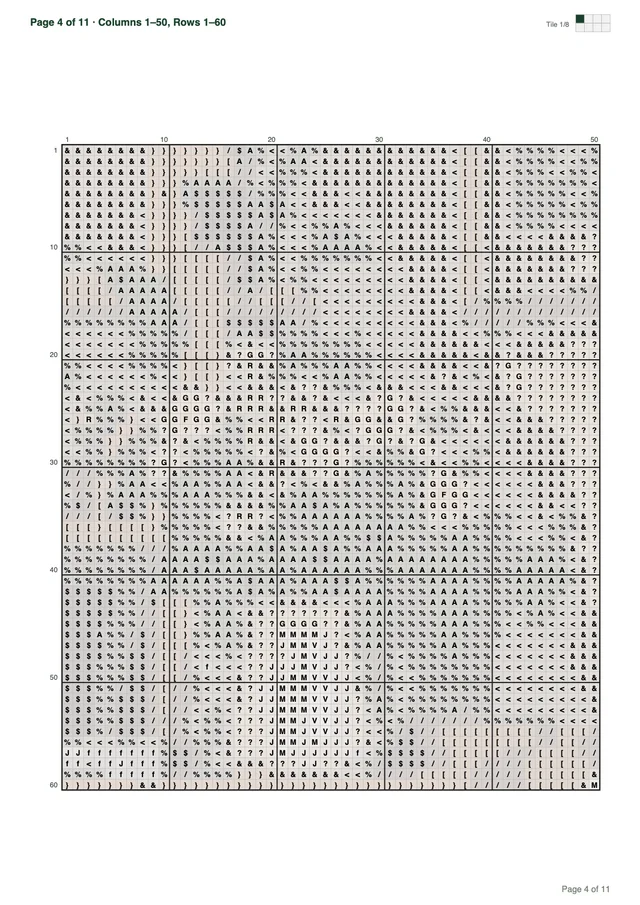
Every download is a multi-page PDF built from your pattern, not a screenshot. This sample was made from the photo above.
Want a different subject? Browse all 67 free patterns
Three transparent steps from your favorite photo to threaded Aida cloth in your hoop.
Choose any portrait, pet snapshot, or keepsake directly from your device.
Set the width in stitches and the maximum DMC thread colors; see the size on Aida 14, 16 and 18.
Spend 1 credit to generate your multi-page symbol chart with floss legend.
Previewing is free. You pay only when you download a new pattern.
Your first pattern is free Sign up and get 1 credit. No card needed.
Make my patternFor one project
$5.99USD
$5.99 per pattern
Buy 1 patternOne for you, two to give
$12.99USD
$17.97 if bought one by oneSave 27%
$4.33 per pattern
Buy 3 patternsFor the whole family
$19.99USD
$35.94 if bought one by oneSave 44%
$3.33 per pattern
Buy 6 patternsPrices in USD, excluding tax: VAT or sales tax is added at checkout where it applies. Payments by Paddle, our merchant of record. By buying you agree to the Terms of Service and the Refund Policy.
Each page explains how to prepare that kind of picture and opens the same pattern maker.
The Cross Stitch pattern maker turns a photo into a counted chart you can print at home: a symbol grid, a list of DMC threads and the finished size on 14-, 16- and 18-count Aida. You pick the photo, the width in stitches and how many colors to use, then check the result on screen before you download anything.
This page explains in plain words what a pattern maker does with your picture, how big the finished piece will be, and how an online tool compares with cross stitch software, phone apps and commissioned charts. We also list what our tool cannot do yet, so you know before you start.
It lays a grid over your photo and turns every square of that grid into one cross, with one DMC thread color and one symbol. Everything else on the chart (the thread list, the sizes, the page layout) follows from that grid.
The width you choose decides how many crosses run across the design. You can pick from 10 to 300 stitches wide, with quick buttons for 50, 80, 100, 150 and 200. The height follows the shape of your photo, so nothing gets stretched. A 4:3 photo at 100 stitches wide becomes a grid of 100 × 75, which is 7,500 crosses. The largest chart allowed is 90,000 squares.
Before the grid is made, you crop the photo. Cropping matters more than any other setting: a face that fills most of the frame keeps its features, while a face in the corner of a wide shot shrinks to a few dozen squares.
A phone photo holds thousands of slightly different shades, and no one wants to buy a skein for each of them. The pattern maker first groups similar shades together, then matches each group to the nearest of 489 DMC floss colors from the MakeBead craft-color-codes dataset (CC BY 4.0). It compares colors the way the human eye sees them (in the CIELAB color space, using the CIEDE2000 formula), not by raw screen values.
You choose the color limit, from 2 to 50, with quick buttons for 10, 20, 30, 40 and 50. When two groups land on the same DMC thread, they are merged, so the final list can be shorter than your limit. In our own test of 11 sample photos at 100 stitches wide and 30 colors, the average color difference per photo ranged from 1.8 to 6.8 on the CIEDE2000 scale. Very bright cyan blues were the hardest: the closest DMC thread was still about 8 away, because cotton floss cannot match a glowing screen. The full method is described on our photo to cross stitch pattern converter page.
Sharp, well-lit photos with one clear subject make the cleanest charts. Before you upload, check three things:
Dark evening snapshots and busy backgrounds turn into scattered single crosses of many colors, which are slow to stitch. Our guides for portrait patterns and pet portraits show what to look for in photos of people and animals.
Each PDF is built for Letter or A4 paper, whichever you choose. It contains:
Our sample chart, a design of 200 × 113 stitches with 48 DMC colors, prints on 11 pages. Smaller designs need fewer pages. You can open that sample in the section above to see the pages before you make your own.
Every setting can be changed as often as you like before you download. The preview updates each time and lists the finished size for all three Aida counts, so there is no fabric to pick in advance.
| Setting | Your choices | What it changes |
|---|---|---|
| Crop | Any part of your photo | What appears in the design |
| Stitch width | 10–300 stitches (presets 50, 80, 100, 150, 200) | Detail and finished size |
| Thread colors | 2–50 (presets 10, 20, 30, 40, 50) | Smoothness of shading and length of the thread list |
| Paper | Letter or A4 | How the chart is split into pages |
| Preview | Artwork view or symbol chart, plus the thread list | How you inspect the result on screen |
Divide the number of stitches by the fabric count. A design 100 stitches wide on Aida 14 measures 100 ÷ 14 = 7.1 inches (18.1 cm) across. A higher count packs more crosses into each inch, so the same chart comes out smaller.
| Width in stitches | Aida 14 | Aida 16 | Aida 18 |
|---|---|---|---|
| 50 | 3.6 in (9.1 cm) | 3.1 in (7.9 cm) | 2.8 in (7.1 cm) |
| 80 | 5.7 in (14.5 cm) | 5.0 in (12.7 cm) | 4.4 in (11.3 cm) |
| 100 | 7.1 in (18.1 cm) | 6.3 in (15.9 cm) | 5.6 in (14.1 cm) |
| 150 | 10.7 in (27.2 cm) | 9.4 in (23.8 cm) | 8.3 in (21.2 cm) |
| 200 | 14.3 in (36.3 cm) | 12.5 in (31.8 cm) | 11.1 in (28.2 cm) |
| 300 | 21.4 in (54.4 cm) | 18.8 in (47.6 cm) | 16.7 in (42.3 cm) |
Add 2 to 4 inches (5 to 10 cm) of plain fabric on every side for the hoop and for framing. If you already own a frame, measure its opening first and choose the width that fits it.
Start with a chart that is easy to read: about 80 to 100 stitches wide, 20 to 30 colors, and Aida 14. Aida 14 has the largest squares of the three counts, so each cross is easier to see and to count. Fewer colors also mean fewer symbols to tell apart and fewer thread changes.
A few habits help when you start stitching from the printed chart:
A design 100 stitches wide from a 4:3 photo has 7,500 crosses. That is a comfortable size for a first framed piece, and it measures 7.1 by 5.4 inches (18.1 by 13.6 cm) on Aida 14.
Choose an online pattern maker when you want a chart from a photo today without installing anything. Choose cross stitch software or a designer when you need lettering, backstitch or the freedom to change single stitches.
There are four common ways to get a chart from a picture. Each suits a different kind of project.
| Option | Install needed | Change single stitches | Lettering and backstitch | Best for |
|---|---|---|---|---|
| Our online pattern maker | No, runs in a browser | No | No | Portraits, pets and keepsake photos |
| Desktop cross stitch software | Yes, on a computer | Usually | Usually | People who draw and edit charts by hand |
| Phone and tablet apps | Yes, from an app store | Depends on the app | Depends on the app | Simple designs on a small screen |
| A commissioned designer | No | The designer does it | On request | Complex pieces with text or special stitches |
Desktop programs give the most control, but they take time to learn. A designer adds real artistry and can hand-tidy a chart, but you pay more and wait for the designer’s turnaround. Our custom cross stitch pattern guide compares doing it yourself with commissioning a chart in more detail.
Our pattern maker makes full cross stitches from a photo, and nothing more yet. Here is what is missing:
If your project needs any of these, our chart can still be a starting point: print it and add a name or an outline by hand.
Every page below uses the same tool. Each one gives advice for a single kind of picture:
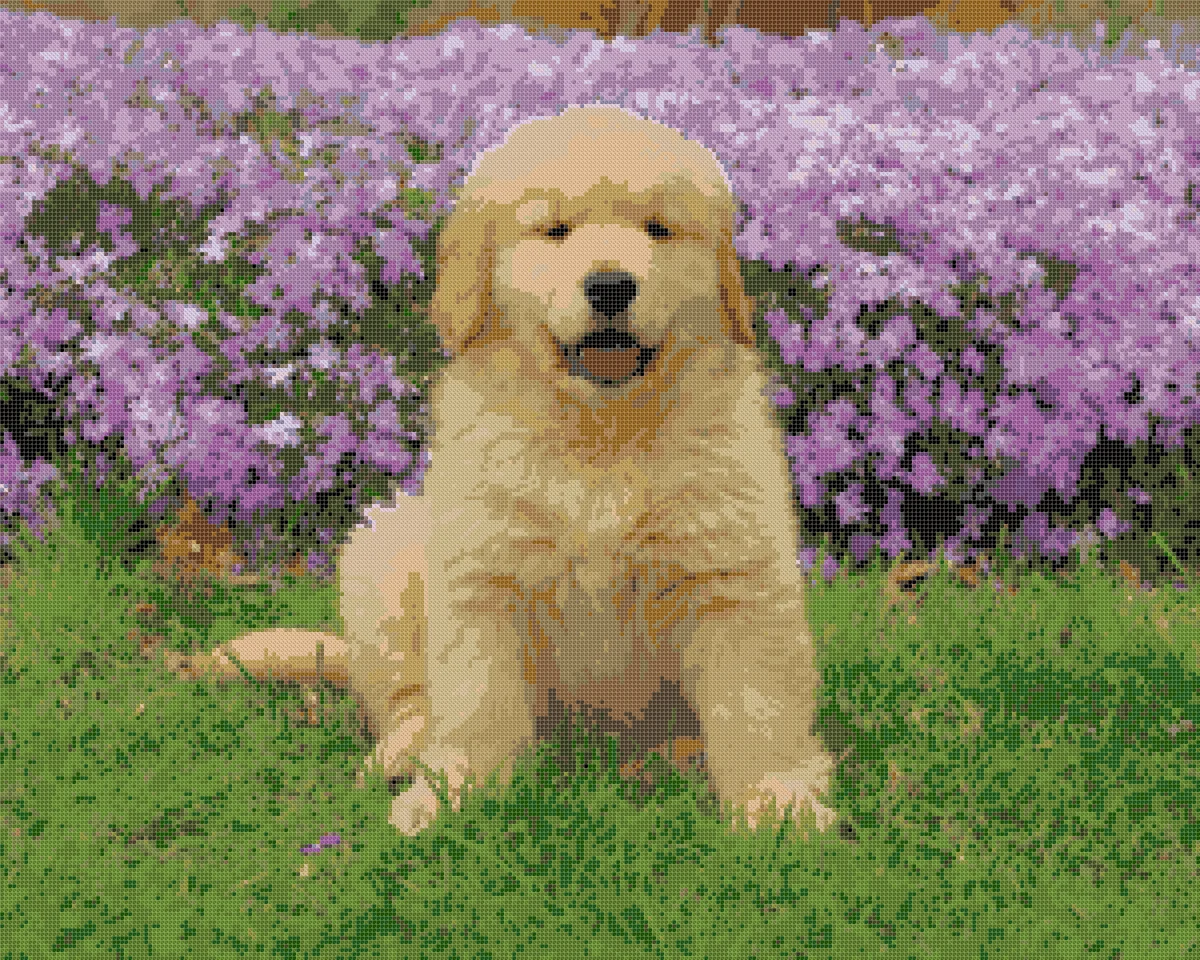
The puppy above was made with this same pattern maker at 300 × 240 stitches with 38 DMC colors. If you would like to understand every step before you begin, read our guide on how to make a cross stitch pattern, from choosing a photo to buying your floss.
Previews cost nothing. You can upload a photo, crop it, change the size and the number of colors, and look through the whole chart without an account. Downloading the printable PDF uses credits: you get 1 free credit when you sign up with Google, each new pattern uses 1 credit, and repeat downloads of the same pattern cost nothing. No credit card is needed to sign up.
No. The pattern maker runs in your web browser on a computer, tablet or phone, so there is nothing to install and nothing to update. Previews are calculated on your own device, which is why the chart changes as soon as you move a setting.
It matches your photo against 489 DMC six-strand cotton floss colors, taken from the MakeBead craft-color-codes dataset (CC BY 4.0). You decide how many of them a chart may use, from 2 to 50. The PDF lists every thread by its DMC number and name, with the number of stitches for each color.
Not yet. The pattern maker creates full cross stitches from a photo, and the chart cannot be edited square by square. There is no lettering, backstitch, fractional stitches or French knots. If your design needs a name or an outline, you can print our chart and add the lettering by hand, or ask a designer to draw it.
While you try settings, the preview is worked out in your browser. When you unlock a new PDF, we keep a reduced copy of your cropped photo (a JPEG of at most 1024 pixels, without camera or location data) and the pattern settings. We use them only to improve our patterns and pages, and we never share, sell or publish your photos. Our privacy page explains the details.
Pick a favorite photo, set the size and the number of colors, and look over the chart before you spend anything. When it looks right, sign up with Google for 1 free credit and let the cross stitch pattern maker turn your preview into a printable PDF: 1 credit per new pattern, and repeat downloads cost nothing.
Try for freeUpload a photo and see your pattern in seconds. No account needed to preview.